Exhibition Dates: October 31 – December 5, 2026
Special Reception: Saturday, November 7, 2026, 2–3 PM
Gallery Hours: Tuesday–Friday, 10 AM–5 PM; Saturday, noon–5 PM; closed Sunday
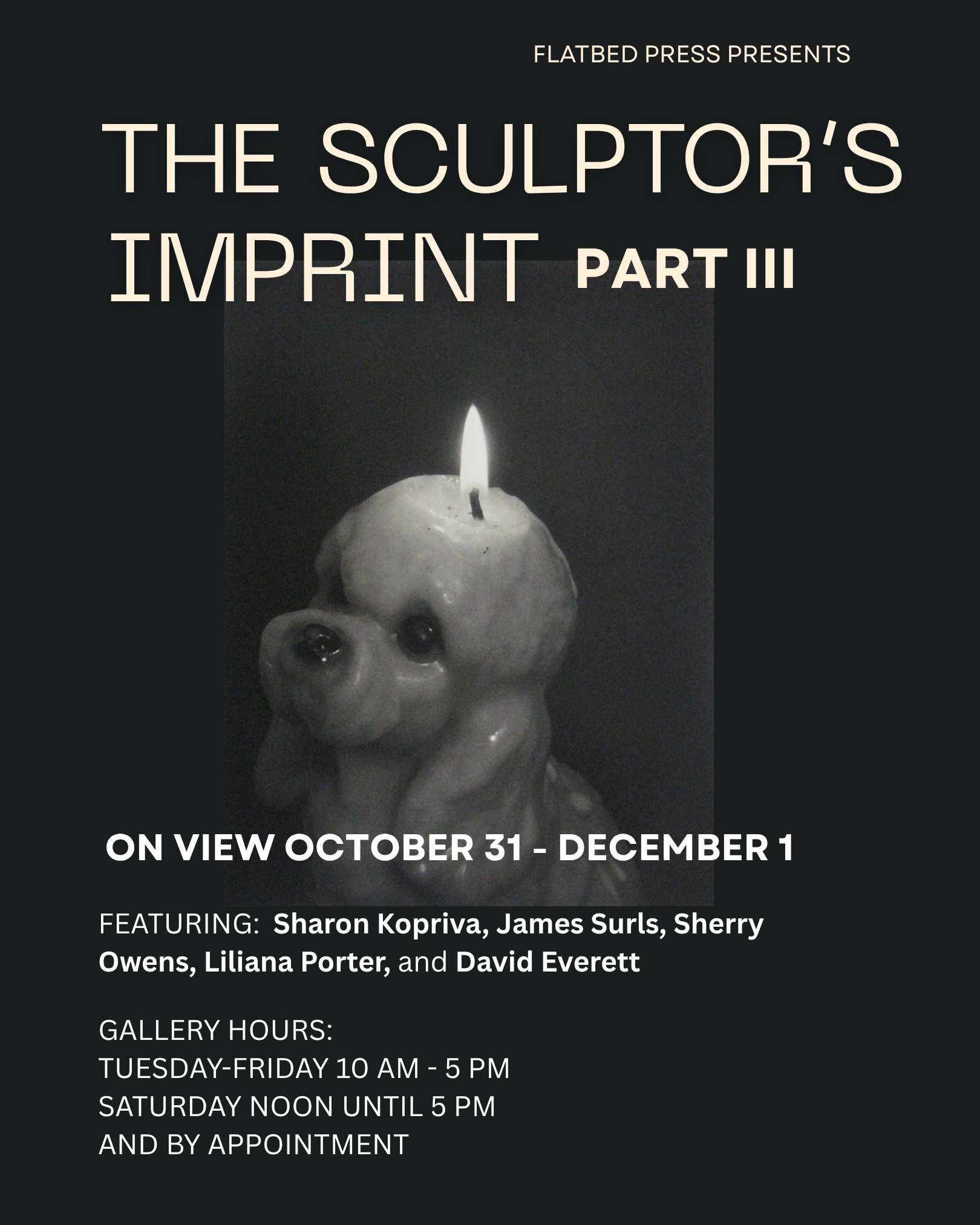
Flatbed Center for Contemporary Printmaking continues its three-part exhibition series, The Sculptor's Imprint, with a third installment featuring prints by five distinctive artists: James Surls, Sherry Owens, Sharon Kopriva, Liliana Porter, and David Everett. The exhibition opens October 31 and continues through December 5, 2026, with a reception on Saturday, November 7, from 1 to 3 PM, featuring a gallery talk by Flatbed co-founder and director Katherine Brimberry.
Sculptors approach their materials with an intimate understanding of physical relationships—how forms occupy space, how surfaces hold texture, and how the manipulation of materials gives shape to ideas. When these artists turn to printmaking, they bring that understanding with them. The resulting works are not simply two-dimensional representations of sculpture, but independent expressions of the same creative investigations.
In this exhibition, the relationship between sculpture and printmaking takes many forms. The directness of carving finds a natural counterpart in the woodcut. The layered complexity of assembled materials becomes a network of etched lines. Sculptural objects become actors in photographic compositions, while the expressive possibilities of color and texture expand an artist's established visual vocabulary. In some instances, even the paper itself becomes an essential part of the artist's exploration of space and meaning.
The Artists
James Surls has long incorporated printmaking into his artistic practice, most often working in relief processes that share a direct relationship with his sculptural approach to carving and form. His imagery draws upon nature, the human body, and the interconnectedness of living things, employing a distinctive vocabulary of eyes, branching forms, and organic structures.
In 1999, during his move from Texas to Colorado, Surls collaborated with Flatbed to create a series of soft-ground etchings printed on both sides of the paper. Conceived around the idea of being in two places at once, these works gave physical expression to a moment of transition. The images occupy opposite sides of a single sheet, suggesting the simultaneous presence of two places, two experiences, and perhaps two states of mind. The use of soft ground, chine collé, and shellac further reveals Surls's willingness to experiment with materials and processes. In these prints, the paper becomes more than a surface for an image; it becomes an integral part of the artist's exploration of space, presence, and belonging.
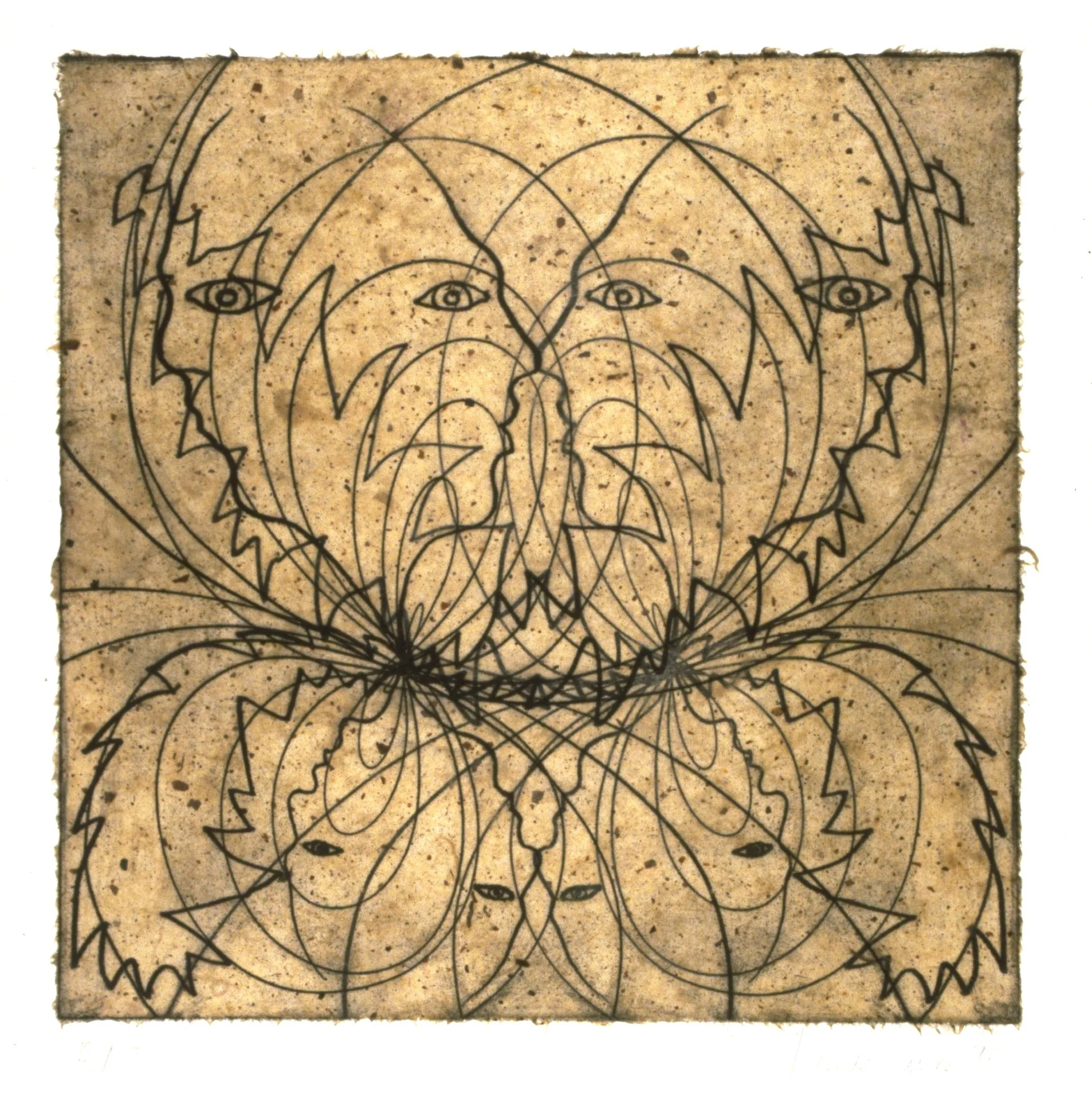
James Surls, “Faces,” chine collé soft-ground etching with shellac, image 12 × 12 inches, 1999.
Sherry Owens is known for her intricate sculptures constructed from natural materials, particularly crape myrtle branches. Her prints reflect this fascination with organic structure and the expressive possibilities of line. Delicate marks intertwine and accumulate into complex compositions that suggest growth, movement, and the interconnected rhythms of the natural world.
In both her sculpture and printmaking, Owens explores the tension between fragility and strength. The branches she uses in her three-dimensional work possess their own histories of growth and transformation, while the lines in her prints seem to follow similarly unpredictable paths. Her compositions suggest living structures, expanding and contracting, twisting and reaching beyond the boundaries of the printed surface. Through these works, Owens reveals the extraordinary complexity and quiet persistence of natural forms.

Sherry Owens, “Restless as the Sea,” color lithograph, image 25 × 39 inches, 2025.
Sharon Kopriva explores mortality, spirituality, and transformation through haunting sculptures and richly expressive imagery. Known for her mysterious, often unsettling figures and environments, Kopriva draws upon religious iconography, mythology, and the cycles of life and death.
Her prints are populated by skeletal animals, birds, and mysterious creatures inhabiting spaces that suggest ancient rituals, sacred architecture, and imagined worlds. Through dramatic color, intricate line, and richly textured surfaces, Kopriva brings the symbolic intensity of her sculptural work to the printed image. Her creatures seem suspended between the physical and spiritual worlds, inviting viewers to contemplate the mysteries of existence and the fragile boundaries between life and death.
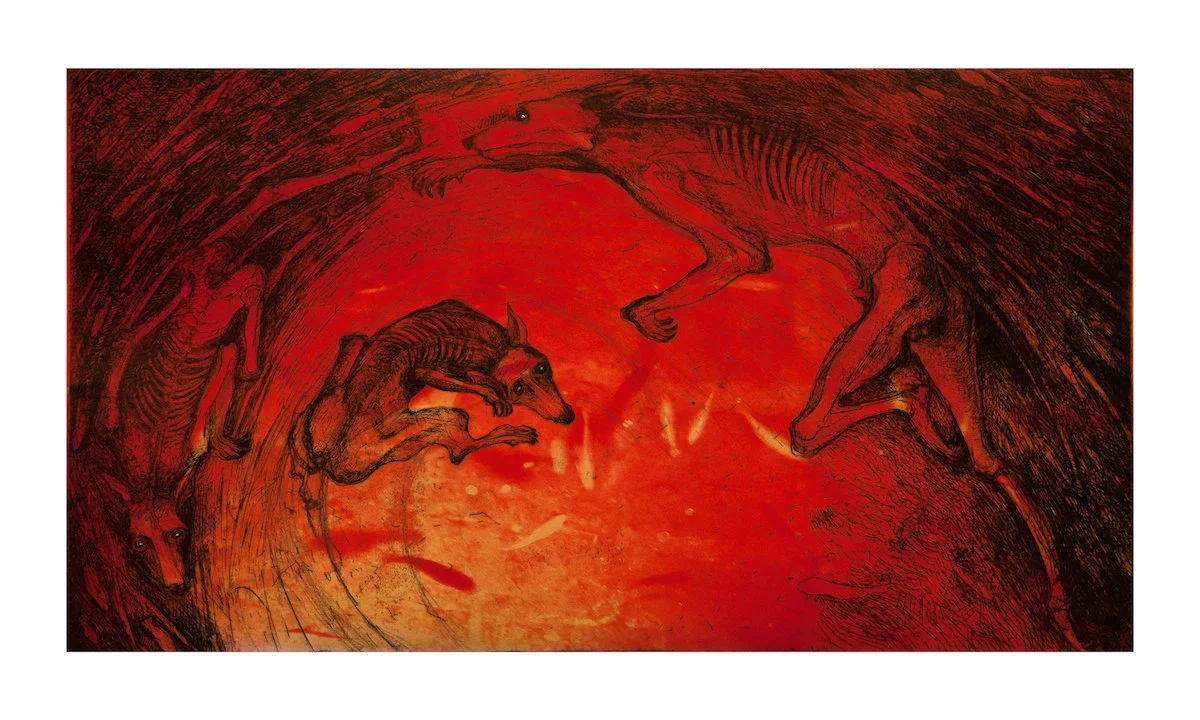
Sharon Kopriva, “Cauldron,” color soft-ground and photo etching, image 9 × 16 inches, 2014.
Liliana Porter has developed a singular artistic language in which ordinary objects become participants in extraordinary situations. Throughout her career, the Argentine-born artist has worked across printmaking, sculpture, photography, and installation, drawing upon an extensive collection of small plastic figures, toys, and found objects. These miniature characters often become the protagonists of elaborate sculptural installations, confronting seemingly impossible tasks involving piles of dirt, tangled string, scattered debris, or other everyday materials. Through unexpected relationships of scale and circumstance, Porter creates scenes that are simultaneously humorous, poignant, and deeply philosophical.
The same figures frequently appear in her prints, where carefully staged arrangements become images that explore the fragile boundaries between reality and representation. In works such as Situation with Dog, an actual plastic figure occupies the same space as a photographic image, dissolving the boundary between the physical object and its representation. Whether gathered together or isolated against an expansive background, these familiar objects take on new identities and suggest narratives that extend far beyond their modest scale. For Porter, the transition between sculpture and printmaking is fluid: the objects become actors, their arrangements become situations, and the printed image offers another space in which their stories unfold.
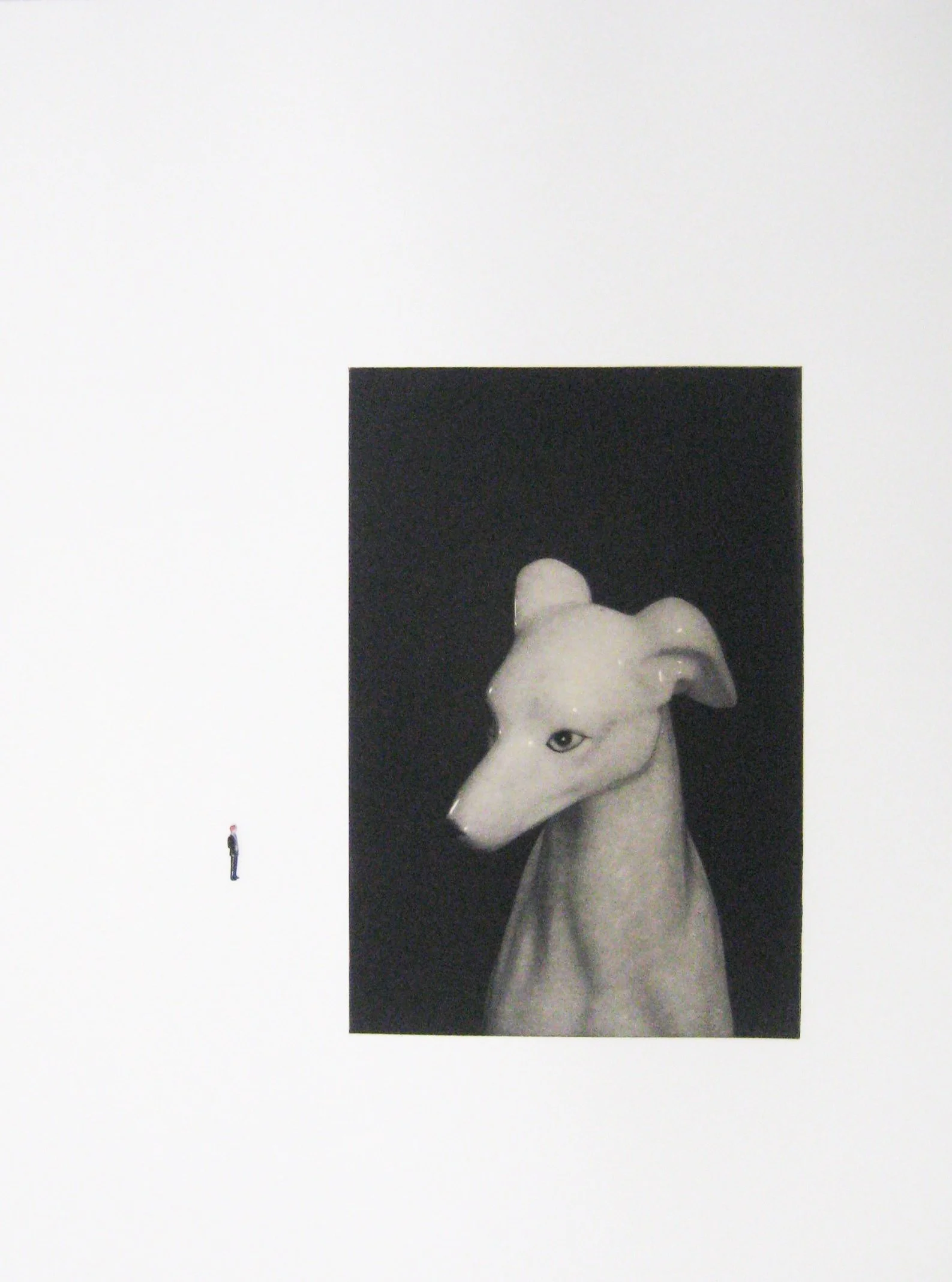
Liliana Porter, “Situation with Dog,” photogravure and plastic man, image 30 × 22 inches, 2009.
David Everett brings the sensibility of a carver to his distinctive woodcuts. Known for his sculptural interpretations of animals and birds, Everett draws upon the natural world to create imagery that combines careful observation with a bold and highly personal visual language.
His woodcuts reveal the close relationship between carving a three-dimensional form and cutting an image into a wooden block. Strong silhouettes, rhythmic marks, and expressive patterns give his birds a remarkable sense of character and physical presence. Each image balances the recognizable qualities of its subject with the artist's playful interpretation of nature. The carved line becomes both a means of description and an expressive gesture, transforming familiar creatures into enduring, almost emblematic forms.
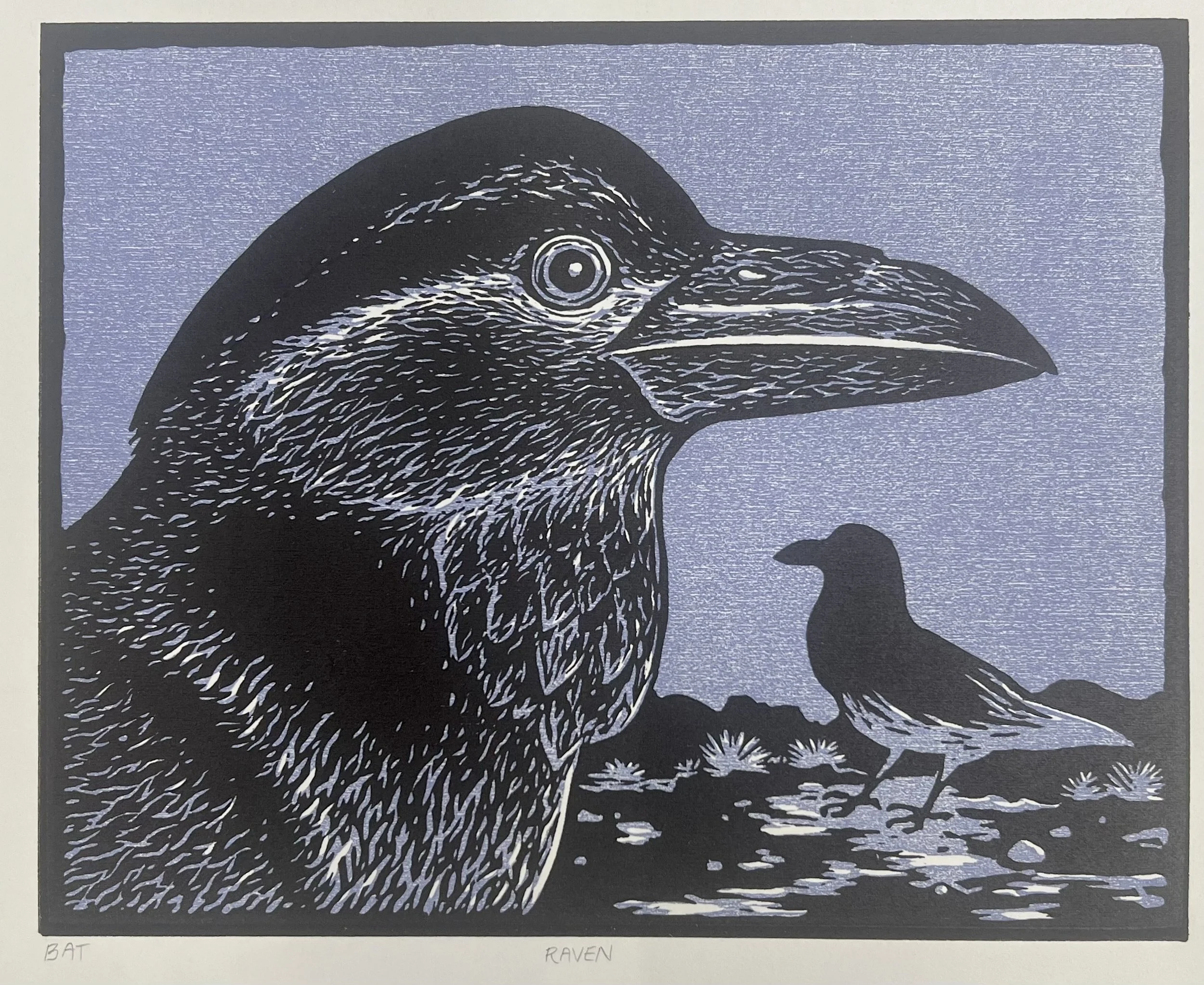
David Everett, “Raven,” chiaroscuro woodcut, image 10 × 8 inches, 2023.
The Sculptor's Imprint
Together, these five artists demonstrate that the relationship between sculpture and printmaking is not defined by dimension alone. It is found in the artist's way of thinking—in the exploration of materials, the construction of form, and the transformation of an idea through the act of making.
For some, printmaking offers a direct extension of sculptural processes through carving, cutting, and building an image. For others, it provides an opportunity to reconsider the relationships between objects, space, and representation. The printed surface may become a place for symbolic narratives, organic structures, or conceptual encounters that would be impossible to express in quite the same way through sculpture.
At Flatbed, where collaboration between artists and master printers has been central to the studio's practice since its founding in 1989, these investigations are especially meaningful. The print studio offers artists opportunities to explore unfamiliar processes, challenge technical conventions, and discover new ways of expressing their ideas. The resulting works reflect not only the individual vision of each artist but also the possibilities that emerge through experimentation and collaboration.
The Sculptor's Imprint, Part III celebrates the rich dialogue between sculpture and printmaking, revealing how an artist's understanding of the physical world can find new and unexpected expression on paper.
Gallery Hours
Monday: By appointment
Tuesday-Friday: 10am-5pm
Saturday: 12pm-5pm
Sunday: Closed